Free Shipping over $99! (most areas) Make Stunning Collages for Free! ✨ New: AI + Human Support is live! Click to chat in any language.



Few figures in history feel as alive as Leonardo da Vinci, the Renaissance master whose boundless curiosity pushed art, science and imagination far beyond the limits of his time. Painter, scientist, engineer, musician, inventor — he was a mind that seemed to overflow in every direction. Born in 1452 in the Tuscan town of Vinci, Leonardo grew up far from the grand libraries and formal education of scholars. But what he lacked in schooling, he compensated with something far rarer: an endless, almost restless curiosity about how the world works.Leonardo da Vinci’s early years in Florence shaped not only his artistic style but also the scientific curiosity that defined his entire life.
A Young Apprentice in a Busy Florence Workshop
Leonardo’s artistic journey began in Florence, where he trained in the bustling workshop of Andrea del Verrocchio — a studio that produced everything from paintings to bronze sculptures. Working in Verrocchio’s workshop allowed Leonardo da Vinci to explore techniques that later became trademarks of the High Renaissance.For a gifted child, this environment was a treasure trove. Leonardo learnt:
- how to draw from live models
- how to paint plants, animals and drapery
- how to prepare for sculpture
- how casting and metalwork were done
- how perspective and light shape what we see
Many talented artists emerged from Verrocchio’s workshop, but Leonardo was different. His mind didn’t stop at “how to paint well”. He wanted to understand everything — from the flow of water, to the anatomy beneath human skin, to the movement of birds.
A Mind Restless for Answers
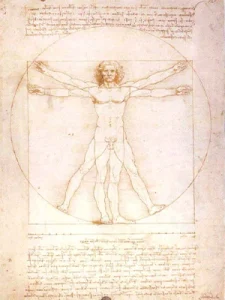
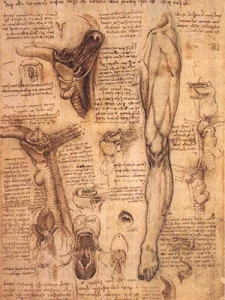
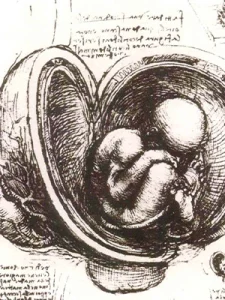
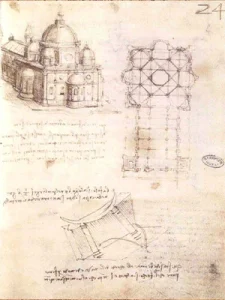
Thanks to his students who preserved his notebooks, we now know how wide Leonardo’s studies stretched. Many of Leonardo da Vinci’s notebooks reveal how closely he observed nature, anatomy and movement as part of his artistic study.Thousands of pages survive, filled with sketches, experiments, diagrams and reading notes. As you flip through these pages, it becomes hard to imagine how one man could explore so many fields so deeply.
He dissected more than thirty human bodies to understand anatomy.
He studied how children developed in the womb.
He observed insects, birds and water currents for years.
He tested how light affects distant colours.
He explored sound, clouds, geology and plant growth.
Through his dissections, Leonardo da Vinci gained an understanding of the human body that was unmatched at the time.Leonardo preferred direct observation over ancient authority. When scholars trusted old texts, Leonardo trusted his eyes. He wrote that the sun does not move — a thought so bold that Galileo would be punished for it a century later. But Leonardo wasn’t trying to be a scientist in the modern sense. For him, understanding nature was a path to creating better art.
Between Cities and Dreams
Around 1482, Leonardo left Florence for Milan, offering his service to Ludovico Sforza not as a painter first, but as a military engineer. He designed canals, fortifications, machines and theatrical devices. Even when rulers admired him as a musician or entertainer, few understood the depth of his ideas.
After Milan fell to the French in 1499, Leonardo travelled between Venice, Florence and Rome, continuing commissions and studies. From 1506 to 1516, he returned to Milan several times, eventually accepting an invitation from King Francis I of France. There, in a quiet castle along the Loire River, Leonardo spent his final years, passing away in 1519.
Changing the Way We See Faces
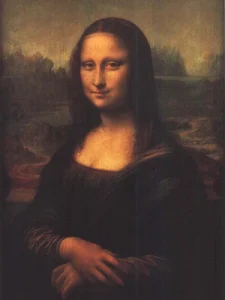
During this period, Leonardo painted one of the most famous works in the world: the Mona Lisa.The Mona Lisa captures Leonardo da Vinci’s mastery of light, anatomy and emotion more clearly than any of his other surviving works. Although scholars still debate the sitter’s identity, Giorgio Vasari believed she was Lisa Gherardo, the wife of Francesco del Giocondo — hence the name La Gioconda.
Before Leonardo, women’s portraits were usually shown in profile, often focused more on jewellery and clothing than personality. Leonardo transformed this tradition by:
- using a relaxed, three-quarter pose
- building the figure with soft, layered shadows instead of hard outlines (the chiaroscuro technique)
- integrating the sitter into a unified atmospheric landscape
- using delicate glazes that create a gentle inner glow
Instead of isolating a figure on a flat background, Leonardo wrapped the entire painting in one soft, shared light. The misty mountains, flowing rivers and subtle colour shifts all echo the sitter’s calm presence.
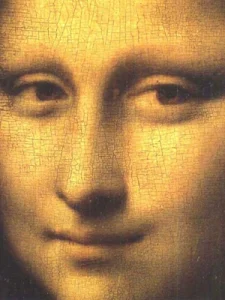
And of course — there’s the smile.
Vasari praised the painting as proof of “how faithfully art can imitate nature”. Yet its true magic is not imitation but emotion. Leonardo wasn’t just painting a face; he was painting a feeling.
A Legacy Larger Than Any One Field
Leonardo rarely published his ideas, perhaps fearing criticism or simply losing interest once he solved a question. He wrote backwards, from right to left, making his notebooks readable only in a mirror. To his contemporaries, he seemed mysterious, even eccentric.
But today, his legacy feels clearer than ever.
He believed that to paint well, one must understand the world deeply — light, anatomy, movement, emotion, physics. He elevated painting from craft to intellectual pursuit, shaping what would become the High Renaissance.
Leonardo da Vinci remains unforgettable not because he mastered one thing, but because he refused to stop at one. His work reminds us that curiosity is not a distraction. It is the starting point of extraordinary things.
References
https://en.wikipedia.org/wiki/Leonardo_da_Vinci
https://www.britannica.com/biography/Leonardo-da-Vinci
https://www.mos.org/leonardo/index.html